
Buckle up, folks. It finally happened. The “AI Gold Rush” that’s been fueling every Silicon Valley pitch deck since 2023 just hit a brick wall at 100 miles per hour. As we roll through 2026, the ticker tapes are bleeding red, and the hype train has officially jumped the tracks.
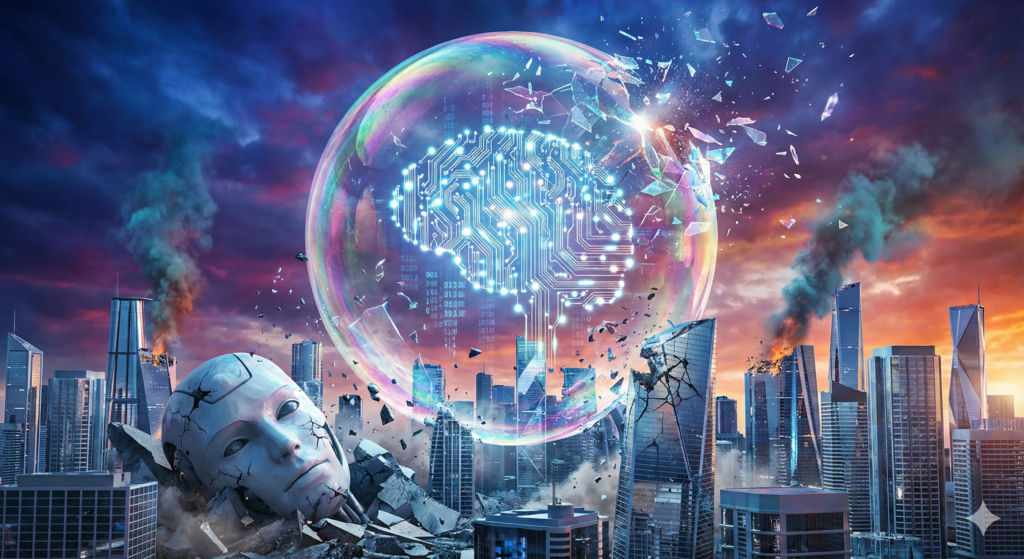
If you’ve been watching the markets, you know the vibe is officially “Rekt.” But before you start panic-selling your soul to a chatbot, let’s talk about why the bubble popped and why—believe it or not—this is the best thing that could’ve happened to tech.
Why the Pin Finally Hit the Balloon
We all saw it coming, but we were too busy “mooning” to care. Here’s the “how-to” guide on how we broke the most expensive toy in the world:
-
The ROI Reality Check: For three years, companies poured billions into “AI integration.” In 2026, the boardrooms finally asked, “Wait, why are we paying $20M a year for a chatbot that still can’t figure out how many ‘R’s’ are in strawberry?” The ROI just wasn’t mathing.
-
The “Circular Funding” Ponzi: Turns out, a huge chunk of the AI market was just tech giants giving money to startups… so those startups could buy chips from the tech giants. It was a giant game of financial “Pass the Parcel,” and the music just stopped.
-
The Grid Grito: We tried to build “God in a Box,” but forgot we needed a plug. The energy demands for these massive clusters hit a ceiling. When you have GPUs you literally cannot plug in because the local power grid will explode, your growth hits a hard cap.
-
AI-Washing Fatigue: Every “smart” toaster and “AI-powered” toothbrush finally pushed consumers over the edge. People stopped buying the hype and started demanding actual utility.
The Silver Lining: Why This Crash is Actually a Win
I know, I know. Seeing your portfolio look like a crime scene isn’t fun. But historically, the best tech isn’t built during the boom—it’s built in the ruins. Here’s why the 2026 crash is a massive “W” for the long term:
1. Killing the “Vaporware”
The market was absolutely saturated with “wrapper startups“—companies that were literally just a fancy UI on top of someone else’s API. This crash is the ultimate “trash day.” It’s flushing out the grifters and the “visionaries” whose only skill was prompt engineering a pitch deck.
2. Talent Re-Allocation
For the last few years, the smartest minds in the world were being paid $600k a year to make sure people clicked on ads more efficiently using LLMs. Now that the “easy money” is gone, those engineers are heading back to projects that actually matter—like climate tech, biotech, and hardware that doesn’t just hallucinate recipes.
3. Lowering the Barrier to Entry
When the bubble pops, the price of “compute” crashes. Suddenly, the GPU hoarding ends. This means the small-time builders—the ones actually trying to solve niche, real-world problems—can finally afford the horsepower to build without needing a $100M seed round from a VC firm in a fleece vest.
4. Forced Utility
We’re moving from the “Look what it can do!” phase to the “What can it do for me?” phase. The survivors of this crash will be the ones focused on boring, high-value tasks: better medical diagnostics, localized energy management, and actual productivity tools. No more dancing avatars; we’re getting tools that work.
The Bottom Line
The 2026 AI crash isn’t the end of Artificial Intelligence; it’s the end of AI as a religion. We’re moving from a speculative fever dream into a mature industry. It’s going to be a bumpy ride for the “bag holders,” but for those of us who actually want to see technology change the world, the air is finally starting to clear.